The Adult ADHD Home: Small Changes That Help My Space Feel Calmer
Some days, my kitchen counter turns into a landing pad. A water bottle, two unopened packages, yesterday’s mail, a half-used candle, and a random sock that somehow traveled from room to room as if it had a plan. There’s also that chair, you know the one, the “I’ll deal with it later” chair that slowly becomes a closet.
If you’re living with adult ADHD, this kind of visual noise can feel extra loud, because a home has a thousand tiny decisions baked into it, and ADHD brains don’t always get relief from those decisions. That’s why adult ADHD home organization needs a gentler approach.
This is not about a perfect house or a weekend-long overhaul. It’s about small, gentle shifts you can repeat, even on a tired day. You’ll walk away with a handful of changes you can try in 10 minutes, plus a few “calm corner” setups that make daily life feel softer.

Why clutter feels louder to me
Clutter isn’t just about things being out of place. For me, it’s about what those things represent. A bag by the door doesn’t feel neutral. It quietly holds five unfinished tasks. Paper stacks turn into mental reminders I didn’t ask for. When I see a pile, my brain fills in all the invisible to-dos attached to it, and the noise adds up fast.
Over time, I realized this wasn’t about motivation or discipline. It was about friction. When my home asks me to remember too much, walk too far, or make too many small decisions, everything feels heavier. The clutter patterns that raise the volume for me. These are the patterns that consistently make my space feel louder than it looks:
- Paper stacks that need sorting
- Half-used bins with mixed items, so nothing feels finished
- Too many choices, like three places the scissors could live
- Stuff without a clear home, so surfaces become storage
- Flat spaces that collect everything, especially counters and dressers
Once I started noticing these patternes, I stopped trying to fix the whole house. I just focused on reducing one trigger at a time. That’s where small wins come in. Removing one decision, one pile, or one friction point can bring immediate relief and make the space feel calmer without a big cleanup.
Small organization changes that calm a room
These are all designed to start in 10 minutes or less. Not because 10 minutes is magical, but because starting has to feel possible. Choose one. Do it once. Let it be imperfect. Your space will still get calmer.
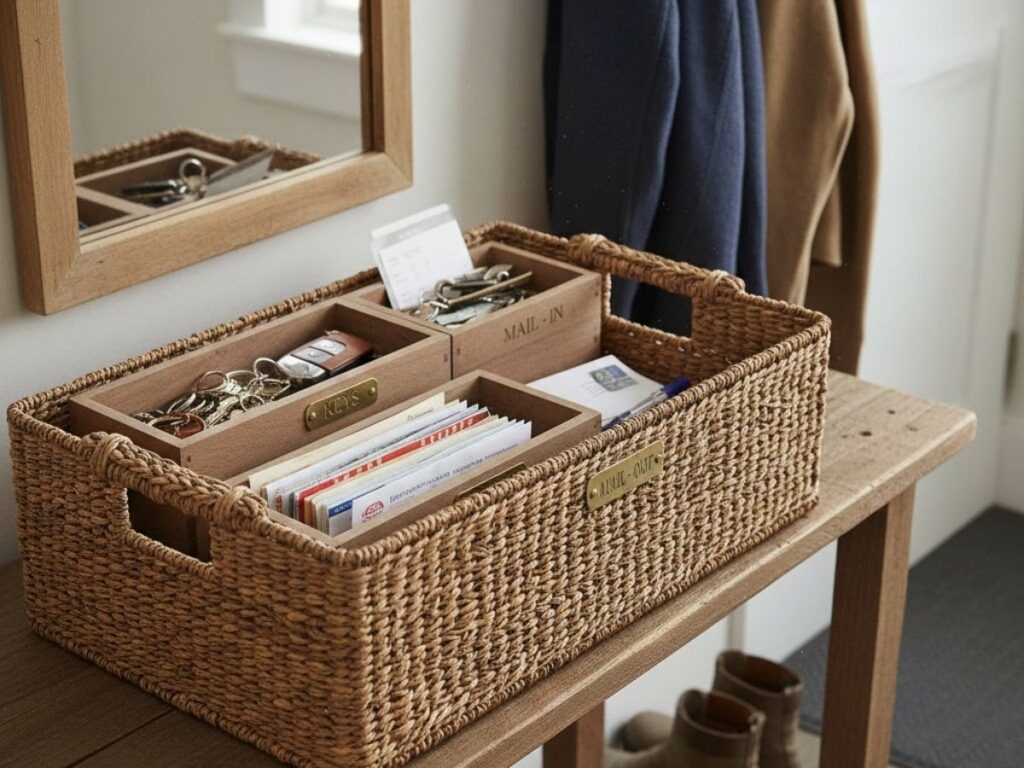
Give every high-use item a home you can reach in one step
If you have to open a cabinet, move a stack, pull out a bin, and then find the thing, your brain may decide it’s not worth it. The item stays out, and the surface becomes a pile again. Try the one-step home rule: the things you use most should go back with one simple move. A few examples that actually stick:
- Keys on a hook right by the door.
- Scissors in the drawer where you open packages, not in a random “office” bin.
- Hair ties in a small dish where you actually use them, not where you think they should live.
Make surfaces boring again with a simple landing pad plan
Counters and nightstands are magnets because they’re easy. They don’t require decisions. You set things down and move on. The goal isn’t to ban stuff from surfaces. It’s to give surfaces a plan. I like a 3-zone surface rule:
- One functional tray (wallet, keys, earbuds, daily meds).
- One pretty item (a candle, a small plant, a framed photo).
- Everything else stays clear.
If something doesn’t fit the tray, it doesn’t belong there. That’s the rule that protects your calm. If you often end up with “I don’t know where this goes” items, add one small basket for the maybes. Call it the “not sure yet” bin. Once a week, do a quick reset and put things away, donate, or toss.
Voice reminders can take a surprising amount of pressure off a forgetful morning. I’ve rounded up the things Alexa can do around the house that have made the biggest difference for us, from recurring reminders to multi-step routines.
Cut the steps with a one-minute reset you can repeat daily
I used to think resets had to be 20 minutes to count. That belief made me avoid them. A one-minute reset changed my house more than any big clean. Set a timer for 60 seconds. Then:
- Return only obvious items to their homes.
- Toss trash.
- Put dishes in the sink or dishwasher.
- Stop when the timer ends, even if it’s not perfect.
Do it while coffee brews, during the intro of a podcast, or right before bed. The power is in repetition, not intensity. If you do one minute a day, your home gets a steady drip of relief.
Keeping it going without burnout
Systems fail when they require you to be a different person. Gentle routines work because they match real life, including the weeks when you’re stretched thin. Expect setbacks, and plan for them. Here are a few common snags, plus quick ways to recover:
- When a bin becomes a junk bin: Empty it, then tighten the category name to something you can answer in one second.
- When laundry piles up: Wash one small load, even if it’s not perfect
- When paper takes over: Do a five-minute “act, file, recycle” sprint and stop.
- When you lose momentum: Pick one surface to clear, not the whole room.
Tie chores to cues, not to a perfect schedule
Schedules can help, but they can also become another thing to fail at. Cues are easier because they ride on habits you already have. Cues work because they remove the “when should I do this?” question. A cue is simple: after X, I do Y. Examples that reduce decisions:
- After brushing teeth, wipe the bathroom sink with a cloth.
- After dinner, clear one counter spot.
- When you take the dog out, take a small trash bag too.
- When you start the coffee, do a 60-second reset.
Plan for “messy weeks” with a minimum standard that still feels good
Messy weeks happen. Travel, work deadlines, low energy, family stuff, winter blues, it all shows up. The house should still feel livable. Set a minimum standard that protects calm without asking for perfection. Mine looks like this:
- One clear surface (usually the kitchen counter).
- Dishes are contained in the sink or dishwasher.
- Walkways open, nothing to trip on.
Add one weekly 15-minute reset for your top two stress spots. Put on music, set a timer, and only work on those two areas. You’re not catching up on life, you’re just lowering the noise. The goal is a home that supports you, not a home that looks like a photo shoot.
When calm comes from asking less of your space
Calm often returns in small, quiet ways. A counter you can actually cook on, an entryway that catches your keys, a bedroom that feels softer at night. None of that requires perfection; it only requires a few repeatable systems that ask less from your brain.
Start with one small change today, then try it for seven days. Let it be a little messy while it becomes familiar. Progress counts, even when it’s tiny, and tiny is often how lasting calm begins.
More To Explore
- Not every disability is visible, and not every need comes with an explanation. The Hidden Disabilities Sunflower offers a quiet, dignified way to signal that someone may need extra time, space, or patience without having to say a word. It is a small symbol with a powerful purpose, reminding us that kindness and understanding should always come first.
- Adult ADHD emotions can feel intense and unpredictable on certain days. In this aritcle, I write about how I steady myself during those emotional rollercoaster moments that help me feel grounded again. It’s a personal look at supporting emotional balance without forcing control or perfection.
- Adult ADHD time management can feel frustrating when time slips away without warning. In this article, I share how I work with my brain instead of relying on memory that help my days feel calmer and more predictable. These habits help me stay oriented without rushing, overcorrecting, or living in constant catch-up mode.
- Adult ADHD overwhelm doesn’t usually arrive as chaos. It builds quietly through small slips, mental noise, and too many open loops. These are the simple, low-effort tactics that actually help me break the overwhelm spiral in real time, without fixing everything or forcing productivity.
- Adult ADHD sensitivity is closely tied to emotional regulation, confidence, and energy levels. Small supports and predictable rhythms can help sensitivity feel more manageable and less overwhelming in everyday life.